
Parc Fermé Energy delivers long-duration, non-degrading energy storage systems designed for critical infrastructure, industry, and national energy resilience.
From grid-scale deployments to mission-critical facilities, we engineer Vanadium Redox Flow Battery (VRFB) solutions that operate reliably for decades — without compromise.
From system architecture to real-world deployment.
Engineering-led system design tailored to load profiles, autonomy requirements, and future scalability — ensuring optimal VRFB sizing and long-term performance.
End-to-end of containerized VRFB systems, including logistics, installation, commissioning, and on-site integration — delivered with precision and repeatability.
Seamless integration with grid infrastructure and renewable generation, enabling stable operation, peak-shaving, and long-duration energy buffering across diverse environments.
Parc Fermé Energy designs, deploys, and supports long-duration energy storage systems built for reliability, safety, and scale.
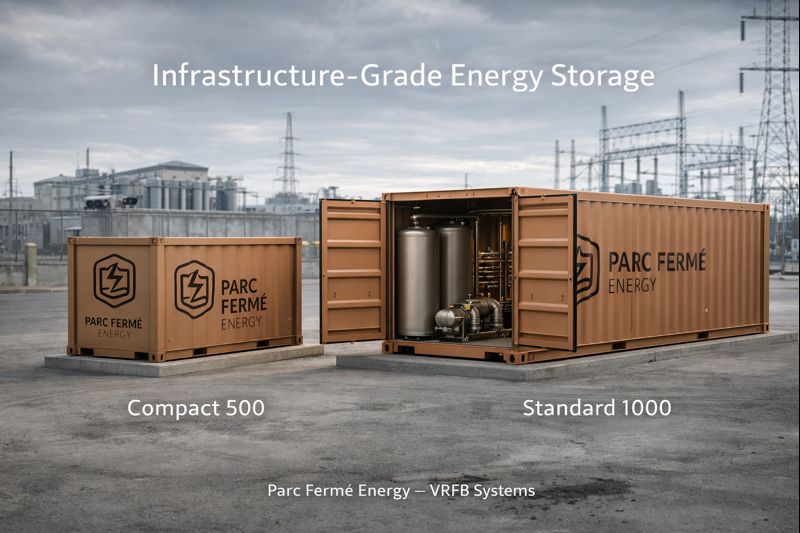
Vanadium Redox Flow Batteries are fundamentally different from conventional lithium-based storage.
They are purpose-built for long-duration, high-cycle applications where reliability matters more than hype.
A flow-based energy storage system engineered for decades of operation.
Unlike conventional batteries, VRFB systems separate energy storage from power generation.
Energy capacity is defined by electrolyte volume, while power is determined by the stack — allowing independent scaling, unlimited cycling, and zero capacity degradation over time.
This architecture enables true long-duration energy storage designed for infrastructure-grade reliability, not consumer electronics.
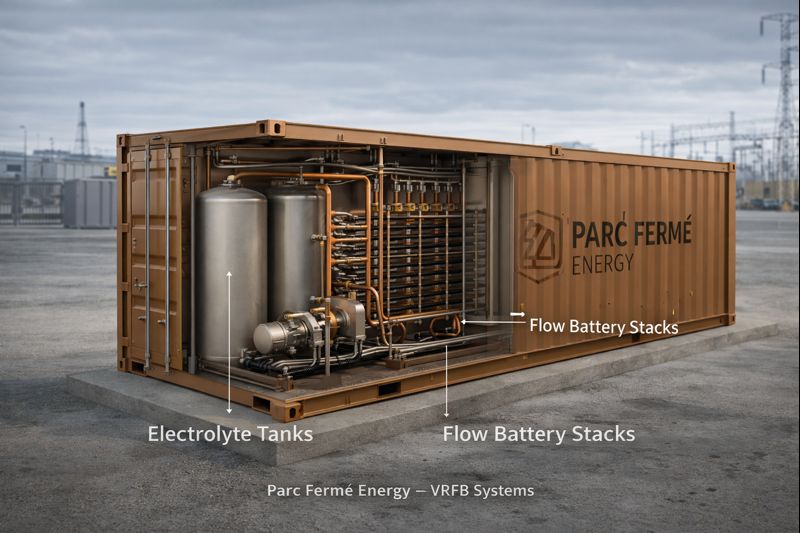
Energy is stored in liquid vanadium electrolyte inside external tanks.
Ion exchange occurs inside the stack — converting flow into electricity.
Electricity is delivered to the grid or load with no degradation.
Electricity is delivered to the grid or load with no degradation.
Why flow batteries scale differently
Energy & Power Decoupled
VRFB systems store energy in liquid electrolyte while power is defined by the stack — allowing independent scaling without redesign.
No Capacity Degradation
Unlike lithium systems, VRFB capacity does not fade with cycling — delivering predictable performance over decades.
Built for Long Duation
Flow batteries are engineered for grid-scale, multi-hour storage where safety, longevity, and uptime matter most.
Built for Long Duation
Flow batteries are engineered for grid-scale, multi-hour storage where safety, longevity, and uptime matter most.
Parc Fermé Energy solutions directly support national and global sustainability mandates — including UAE Net Zero 2050 and Vision 2030 — by enabling reliable, infrastructure-scale energy storage.
By allowing renewable energy to be stored and dispatched on demand, VRFB systems reduce reliance on fossil-fuel peaking plants, eliminate short-lived battery waste, and enable measurable, long-term carbon reduction at grid scale.
Designed to align with national energy strategies, utility-scale decarbonization programs, and long-term grid resilience requirements.
This is long-term sustainability — not short-term offsetting.

Where VRFB delivers long-duration resilience — across infrastructure-grade systems.
Long-duration energy storage for grid balancing, renewable firming, and peak-load management.
Designed for daily cycling, multi-decade operation, and utility-grade reliability — without capacity degradation.
Enables solar and wind assets to deliver dispatchable power on demand.
Reduces curtailment, stabilizes grid frequency, and supports long-term decarbonization targets at national scale.
Continuous power availability for energy-intensive operations.
Protects production uptime, mitigates grid instability, and reduces fossil-fuel backup systems.
Non-flammable, non-degrading energy storage for mission-critical digital assets.
Built for high-cycle operation, extended autonomy windows, and infrastructure-grade safety standards.
Long-duration renewable storage for off-grid and weak-grid environments.
Reduces diesel dependence, simplifies logistics, and enables autonomous operation in harsh conditions.
Infrastructure-grade storage designed to your load profile.
Based on your inputs, we estimate the required energy capacity and system configuration.